
Upgrade your home with Cavity Wall Insulation Manchester, a proven energy efficiency solution that reduces heat loss through external walls and helps maintain a consistently warm indoor environment. It is especially effective for older properties with uninsulated cavity walls.This simple retrofit improvement lowers heating costs, improves thermal comfort, and boosts your home’s EPC rating, making your property more energy-efficient, cost-saving, and environmentally friendly in the long term.
Around one-third of the heat lost from an uninsulated home can escape through the walls. Suitable cavity wall insulation can reduce this heat loss and improve energy efficiency.
Cavity walls: Two brick layers with a gap (typically 50-100mm). Homes built 1920s-1990s. Most Manchester homes from this period are suitable.
Solid walls: No cavity. Choose internal or external wall insulation instead. Typical in pre-1920s Victorian and Edwardian properties.
Minimum 50mm cavity required for effective insulation. Standard cavity width in Manchester homes is 50-75mm for 1930s-1960s properties, 75-100mm for 1970s-1990s properties.
Walls must be in good condition — no significant damp, no cracks wider than 5mm, no loose or missing pointing.
Properties in very exposed locations (exposed hills, coastal areas, high wind zones) may not be suitable. Most Manchester homes are not in exposed locations, but we assess individually.
Reduce heating costs by 25-35%. Save £200-£400 per year on heating bills for a typical Manchester home.
Cavity wall insulation pays for itself in 2-5 years through energy savings.
Cavity Insulation Guarantee Agency (CIGA) 25-year guarantee on all installations. Protects you if problems arise with the insulation.
Reduce draughts and cold spots on external walls. Improve comfort in rooms with exterior walls.
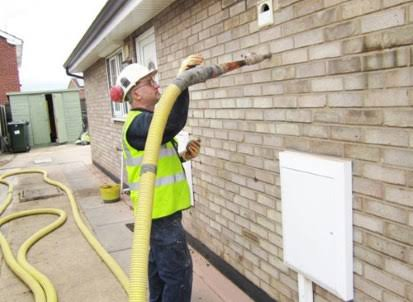
The installation process is simple, minimally invasive, and usually completed within a short timeframe, with very little disruption to the household.
The process begins with a detailed inspection of the property. Small inspection holes may be drilled to assess cavity width, wall condition, and suitability. A borescope camera is often used to check for debris, damp issues, or obstructions inside the cavity before installation is approved.
Once the property is confirmed suitable, small holes (typically around 22mm in diameter) are drilled into the external brickwork. These holes are spaced at regular intervals, usually around 1 metre apart, and arranged in a staggered pattern to ensure even coverage of the cavity.
Specialist equipment is then used to inject insulation material—such as mineral wool fibres or bonded EPS beads—into the cavity. The material flows through the wall space and gradually fills the cavity from bottom to top, ensuring consistent coverage and thermal performance.
After injection, installers may carry out checks using endoscopic inspection or thermal imaging to ensure the cavity has been fully and evenly filled, with no voids or missed areas.
Finally, all drilled holes are carefully sealed using mortar that is colour-matched to the existing brickwork. This ensures the external appearance of the wall is restored and blends seamlessly with the surrounding surface.
Overall, the process improves thermal efficiency while maintaining the structural integrity and appearance of the building.
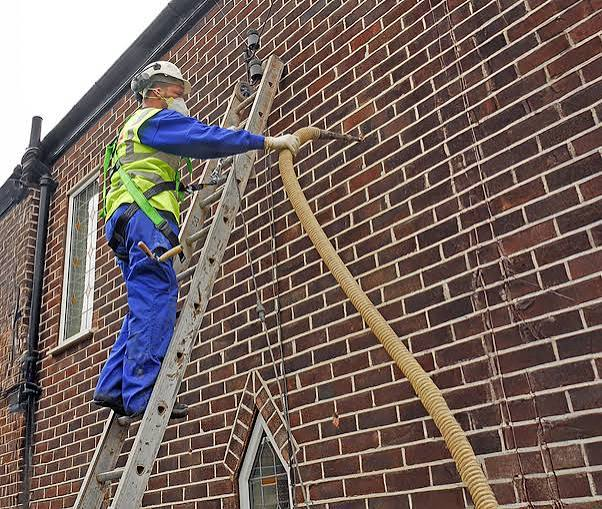
We use approved cavity wall insulation materials selected according to property type, cavity condition, and exposure level to ensure safe, efficient, and long-lasting performance.
A popular option for most Manchester homes, mineral wool beads provide strong thermal efficiency, fire resistance, and breathability. They distribute evenly within the cavity and are suitable for standard wall conditions.
EPS beads are lightweight, water-repellent, and designed to fill cavities evenly when installed with a bonding agent. They are commonly used in exposed or moisture-sensitive areas due to their resistance to water absorption.
This material is used only in specific cases, mainly older properties with narrow or irregular cavities. It expands to fill gaps and provides continuous insulation, but suitability depends on a full property survey.
All materials are sourced from approved systems and installed according to manufacturer guidelines and relevant UK standards, with eligible installations registered for independent guarantees such as CIGA where applicable.
We assess wall construction, cavity size, condition, and suitability. BBA-approved survey. Includes:
Our certified team installs insulation using approved methods. Installation takes 2-4 hours for a typical Manchester home.
We inspect fill quality using thermal imaging or endoscope. Refill any missed areas.
We register your installation with CIGA for 25-year guarantee. You receive a CIGA guarantee certificate within 4-6 weeks.

Cavity wall insulation in Manchester typically costs between £500 and £1,500 depending on property type and wall condition. Most homes are eligible for ECO4 funding, which can significantly reduce or fully cover installation costs.
| Property Type | Typical Areas in Manchester | Estimated Cost | ECO4 Grant Support | Final Cost (If Eligible) |
|---|---|---|---|---|
| Terraced House | Levenshulme, Burnage, Withington | £500 – £800 | Up to 100% funded | £0 |
| Semi-Detached | Stockport, Oldham, Droylsden | £600 – £1,000 | Up to 100% funded | £0 |
| Detached House | Bramhall, Didsbury, Hale | £800 – £1,500 | Up to 100% funded | £0 |
Eligible households may receive full or partial ECO4 funding, subject to property assessment, supplier approval, scheme availability and technical suitability. Eligibility does not guarantee funding, and a customer contribution may be required.
Choosing Compliant Retrofits means working with a professional insulation team focused on quality installation, regulatory compliance, and long-term energy performance. We follow industry-approved methods to ensure every project is assessed, installed, and certified correctly, giving homeowners confidence in both safety and efficiency.
All eligible cavity wall insulation projects are registered with CIGA, providing a 25-year guarantee for added peace of mind and long-term protection against installation-related defects.
CWe use tested and approved insulation products that meet British Board of Agrément (BBA) standards, ensuring reliable thermal performance, durability, and suitability for UK housing conditions.
Our team helps you understand available ECO4 funding options, checks your eligibility, and manages the application and documentation process to make everything straightforward and stress-free.
Every property is carefully assessed before any work begins, including cavity inspection, wall condition checks, and suitability testing to ensure the installation is appropriate and risk-free.
From initial consultation to final certification, we manage the entire process, including installation planning, quality checks, and post-installation documentation.
We offer a no-obligation survey and funding assessment so you can understand your options, expected outcomes, and property suitability before committing to any work.

A: Cavity walls are typically found in homes built 1920s-1990s. Check the brick pattern — cavity walls have even, regular bricks all showing the long side (stretcher bond). Solid walls have alternating long and short bricks.
A: Yes, when installed correctly by certified professionals. We use non-absorbent materials, assess cavity condition before installation, and provide CIGA 25-year guarantee.
A: No, if installed correctly. We assess your property for exposure and wall condition before installation. Cavity wall insulation does not cause damp — it can actually reduce condensation on internal walls.
A: 40+ years with no maintenance required. Mineral wool and polystyrene beads do not degrade over time.
A: Yes, if you receive qualifying benefits or meet ECO4 Flex criteria. Contact us for a free eligibility check.
A: CIGA (Cavity Insulation Guarantee Agency) provides a 25-year guarantee on cavity wall insulation. If problems occur (e.g., damp, cold spots), CIGA covers remediation.